

SE Projects
A group of 4 students, Raja Dilawar Riaz (Group Leader), Usama Majid, Ammar Ali, and Muhammad Faizan, developed “Pakistan’s First 3D Concrete Printer” as per the vision of their supervisor, Dr. Muhammad Usman (HoD Structures Department, NUST Institute of Civil Engineering). Pakistan is an underdeveloped country with a construction sector worth 380 billion PKR in GDP. The construction sector will likely grow by 92% in the coming 7 years. However, how construction is carried out in Pakistan is quite old compared to what is practiced in international countries. Conventional construction in Pakistan creates a lot of challenges like high costs, labor inefficiency, and slow construction times. A country with an increased population and more burden on the housing sector needs this technology. However, in the context of the economic crunch and high import taxation, it cannot afford to import this.
Realizing that required solutions could be developed within the boundaries of the country, the team developed Pakistan’s First Concrete Printer at NUST. The fabrication and design are completely developed within Pakistan (Patent Files under application number 22150-D at IPO Pakistan). The prototype has printable dimensions of 1m x 1m x 0.5 with 3-axis movements, as shown in Figure.
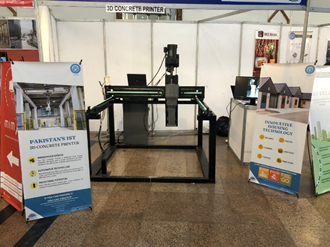
The printing has been done using a mixed design containing locally available materials like cement, sand, fly ash, plasticizer, and fibers. The compressive strength, flexural strength, interlayer bonding, and other mechanical and rheological strength parameters have been assessed by the team and are compared with the conventional casted samples. The results show the same mechanical properties of concrete (with the capacity to be further researched) with a significant reduction in cost and effort. The team appeared on various national and international media platforms describing the future of digital construction in Pakistan. Their first media appearance was on Pakistan Television Network’s morning show at Subeh Pakistan, where they described its potential. They also got recognition from Samaa News, ProPakistani, Economy, StatupPK, Islamabad Times, Truth International, etc. They were also awarded a research grant by Bestway Cement Pvt Ltd and the Pakistan Engineering Council (PEC). Their home department even recognized their project and was awarded as Best Industrial Project Award for UG 2019. The team also holds various international publications on this topic.
The project is being led by Dr. Rao Arsalan Khushnood of the NUST Institute of Civil Engineering, with Dr. Shazim Ali Memon and Dr. Umair Manzoor serving as co-project investigators. The objective of the project is to develop smart multifunctional surface preservation and restoration technologies for paved concrete surfaces, with a focus on runways, taxiways, and airport aprons. The research is centered around pavement and bridge deck, repair materials for spall and partial depth patching, and erosion-resistant durable base layers incorporating nano-engineering practices and other advanced technologies. The research approach includes developing mix designs for optimization, conducting an experimental program, and investigating the effects of smart nano-intrusions on thermal properties. The team also conducted microstructural investigations and utilized surfactant gum to facilitate dispersion of graphite in the cementitious matrix. The reseach concludes with a summary of the project’s achievements, including the successful development of a smart multifunctional surface preservation and restoration technology for paved concrete surfaces. The team also disseminated their results through journal papers at national and international conferences.
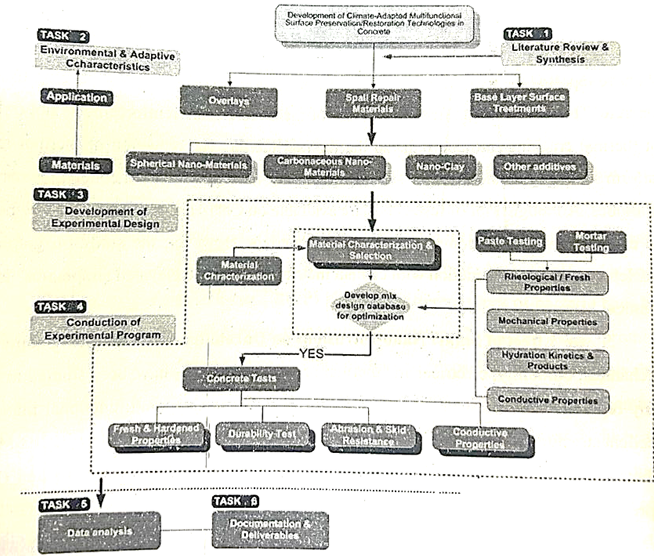
Flowchart of Research Approach
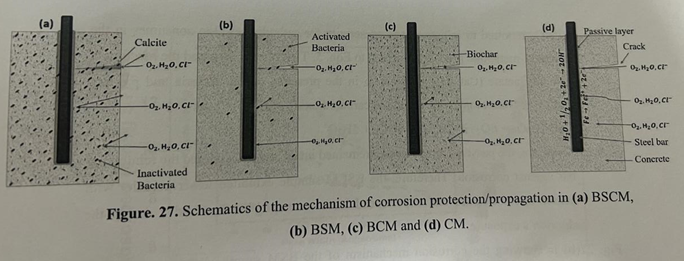
Schematics of mechanism of corrosion protection/propagation in a) BSCM, b) BSM, c) BCM d) CM
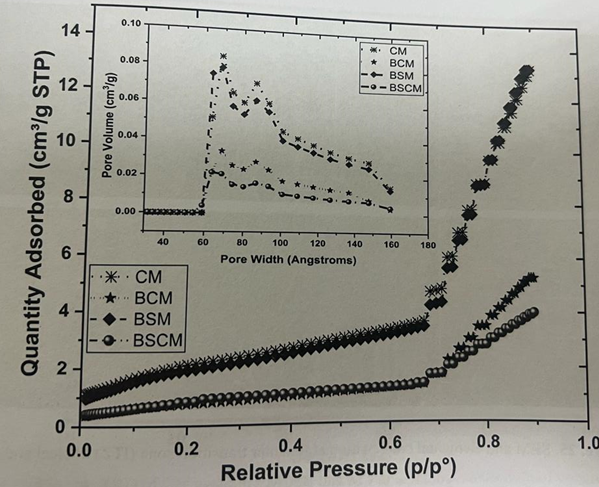
BET N2-adsorption isotherms and porosity curves of all analyzed concrete samples.