

Dr. Muhammad Usman
Pakistan’s First 3D Concrete Printer:
A group of 4 students, Raja Dilawar Riaz (Group Leader), Usama Majid, Ammar Ali, and Muhammad Faizan, developed “Pakistan’s First 3D Concrete Printer” as per the vision of their supervisor, Dr. Muhammad Usman (HoD Structures Department, NUST Institute of Civil Engineering). Pakistan is an underdeveloped country with a construction sector worth 380 billion PKR in GDP. The construction sector will likely grow by 92% in the coming 7 years. However, how construction is carried out in Pakistan is quite old compared to what is practiced in international countries. Conventional construction in Pakistan creates a lot of challenges like high costs, labor inefficiency, and slow construction times. A country with an increased population and more burden on the housing sector needs this technology. However, in the context of the economic crunch and high import taxation, it cannot afford to import this.
Realizing that required solutions could be developed within the boundaries of the country, the team developed Pakistan’s First Concrete Printer at NUST. The fabrication and design are completely developed within Pakistan (Patent Files under application number 22150-D at IPO Pakistan). The prototype has printable dimensions of 1m x 1m x 0.5 with 3-axis movements, as shown in Figure 1.
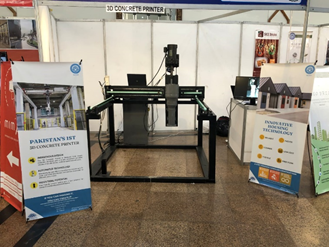
Figure 1: Concrete Printer first showcased at First International Housing Expo’22 by Federal Ministry of Housing Pakistan
The printing has been done using a mixed design containing locally available materials like cement, sand, fly ash, plasticizer, and fibers. The compressive strength, flexural strength, interlayer bonding, and other mechanical and rheological strength parameters have been assessed by the team and are compared with the conventional casted samples. The results show the same mechanical properties of concrete (with the capacity to be further researched) with a significant reduction in cost and effort. The team appeared on various national and international media platforms describing the future of digital construction in Pakistan. Their first media appearance was on Pakistan Television Network’s morning show at Subeh Pakistan, where they described its potential. They also got recognition from Samaa News, ProPakistani, Economy, StatupPK, Islamabad Times, Truth International, etc. They were also awarded a research grant by Bestway Cement Pvt Ltd and the Pakistan Engineering Council (PEC). Their home department even recognized their project and was awarded as Best Industrial Project Award for UG 2019. The team also holds various international publications on this topic.
Feasibility study of smart MRE-based base isolation system for large-scale application in civil engineering structures
This research focuses on developing a smart base isolation system for high-rise buildings and bridges to enhance safety and sustainability against seismic forces, particularly earthquakes. Conventional fixed base structures face challenges like attracting greater forces, amplifying accelerations, and requiring expensive designs. Base isolation, a departure from conventional methods, introduces a soft layer at the foundation, decoupling the structure from ground vibrations. While passive and hybrid systems have shown success, limitations remain, prompting the exploration of Magnetorheological Elastomers (MREs) as a smart material alternative. MREs, composed of elastomeric matrices with magnetic filler particles, offer controllable shear modulus under a magnetic field. This allows for dynamic adjustment of stiffness, addressing shortcomings of traditional systems. The advantage of MREs is their stiffness can be repeatedly and reversibly changed. Isotropic MREs, simpler to fabricate, provide versatility and cost-effectiveness, making them increasingly relevant for industrial applications. The research emphasizes the potential of MRE-based smart base isolators to revolutionize seismic protection, offering improved performance, reduced maintenance costs, and enhanced structural stability in the face of unpredictable earthquakes.
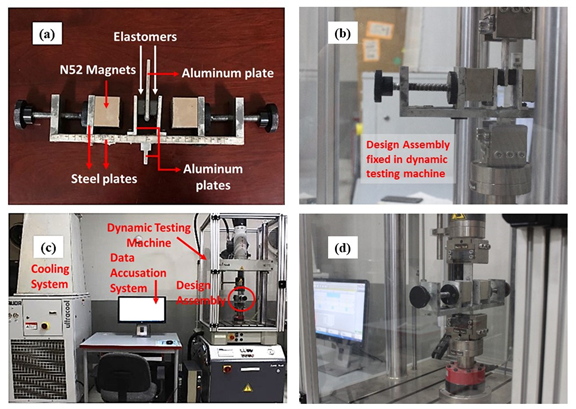
Experimental assembly and setup for dynamic testing of MRES.